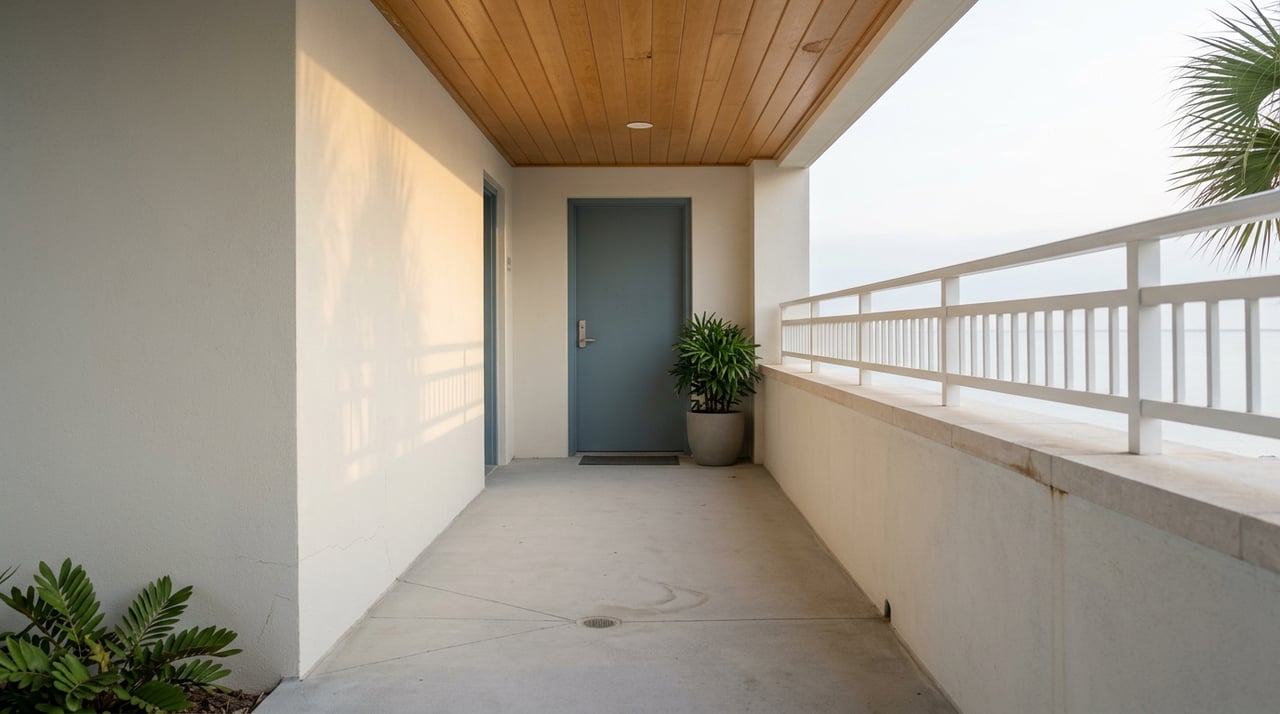
In June 2025, the board at Pinnacle Port Condominiums approved a 2025-2026 budget that left out one thing: funding for its Structural Integrity Reserve Study. The board used a provision built into Florida's newly passed HB 913 to pause SIRS contributions temporarily, prioritizing repairs flagged by a recent milestone inspection instead. That fiscal year closed this past June, and the board now has to decide how it resumes full funding under the stricter rules that took effect January 1, 2026. It was a legal move. It is also exactly the kind of decision a buyer needs to understand before making an offer on a unit in that building, or in any of the dozens of Gulf-front towers along Front Beach Road working through the same math right now.
For years, the shortcut for comparing Panama City Beach condos was simple: check the monthly HOA fee, lower wins. That shortcut stopped working on January 1, 2026, when Florida's reserve-funding mandate went fully into effect. A low fee used to mean a good deal. Now it just as often means a board that spent the last decade underfunding the very repairs the law now forces into the open.
What actually changed, and when
Florida's condo reform started with Senate Bill 4-D, signed in May 2022 after the June 2021 collapse of Champlain Towers South in Surfside, which killed 98 people. That building was 12 stories, built in 1981, and its structural problems had been documented in a 2018 engineering report. A $15 million remediation plan had been approved by its board. The work never started.
SB 4-D created two requirements for any condo or co-op building three stories or taller: a milestone structural inspection, triggered at 30 years of age (25 years for buildings within three miles of the coast, which covers essentially all of PCB's Gulf-front inventory) and repeated every ten years, and a Structural Integrity Reserve Study, or SIRS, which forces associations to fund repairs for eight specific structural components rather than letting owners vote to keep dues artificially low.
HB 913, signed in 2025 and effective July 1 of that year, adjusted the timeline but did not soften the core requirement. The deadline for existing owner-controlled associations to complete their first SIRS moved to December 31, 2025, a date that has now passed. Associations whose milestone inspection is also due on or before December 31, 2026 were given a narrow allowance to complete both studies together, but no later than that date. As of today, most PCB buildings covered by the law should already have a completed SIRS on file.
The bigger shift for buyers is the funding rule. For budgets adopted after December 31, 2024, boards can no longer vote to waive or reduce reserves for the eight mandatory structural items: roof, primary structural systems, fire protection systems, plumbing, electrical systems, waterproofing and exterior painting, windows, and exterior doors. Full funding became mandatory on January 1, 2026. HB 913 did add flexibility on the funding mechanism itself, allowing associations to use loans, lines of credit, or special assessments alongside monthly dues, provided a majority of unit owners approves it.
That flexibility is why Pinnacle Port's pause matters as an example rather than an outlier. The law lets a board redirect money toward urgent milestone repairs for up to two budget years before resuming full SIRS contributions. It is a legitimate tool. It is also a signal that the building's reserve account is not yet where the law requires it to end up, and a buyer closing during that window is stepping into an association mid-catch-up.
The rule change in one table
| Before December 31, 2024 | Now (2026) | |
|---|---|---|
| Reserve funding for structural items | Owners could vote to waive or underfund | Cannot be waived, regardless of vote |
| Reserve threshold for "big-ticket" items | $10,000 | $25,000, adjusted annually ($25,675 for 2026) |
| Funding tools available | Primarily monthly dues | Dues, plus loans, lines of credit, or special assessments with owner approval |
| Disclosure to buyers | Inconsistent across associations | Any assessment or loan for reserves must appear in the annual financial statement and in resale disclosure |
Why the cheap building is the one to question
Panama City Beach's median condo association fee sits around $831 a month as of early 2026. That figure hides a wide range: inland villas and townhomes often run $300 to $500, while beachfront towers with full amenity packages, master insurance, and elevator maintenance frequently clear $1,000 or more. The instinct is to treat the low end of that range as the value play. Under the current law, that instinct needs a second look.
A high monthly fee in a Gulf-front high-rise is often paying for exactly what the law now requires: full insurance coverage, utilities, and a structural reserve account that is actually funded to the level its SIRS calls for. A suspiciously low fee in a building of the same age and height is no longer just frugal management. It is a building that has to close the funding gap somehow, and the two tools available are a special assessment or association debt, both of which a buyer inherits the moment they close.
Statewide, the dollar figures on the other side of that gap are not abstract. Cricket Club, a bay-front building in North Miami built in 1975, levied assessments around $134,000 per unit after its milestone inspection findings came in. Palm Bay Yacht Club, a 27-story, 235-unit building in Miami, approved a combined $46 million in assessments, reaching roughly $175,000 per unit. Mediterranean Village in Aventura saw individual assessments reported as high as $400,000. Those are South Florida towers, not Bay County ones, but they show what "underfunded" turns into once a milestone inspection forces the issue. PCB's Front Beach Road corridor, much of it built in the 2000s and carrying its own post-Hurricane Michael repair history, is not exempt from the same math simply because its buildings are younger.
Age matters less here than height. The SIRS requirement is triggered by a building being three stories or taller, not by how old it is. A tower built in 2020 needs a SIRS on file just as much as one built in 1985. The milestone inspection's age trigger is separate and comes later, but the reserve-funding clock started for every qualifying PCB building the moment the law took effect.
What to ask for before you write an offer
Florida law entitles a buyer to request an association's governing documents, and the current disclosure rules make several of the most important ones easier to get than they used to be. Before making an offer on any Gulf-front condo in Calypso, Tidewater Beach Resort, Sterling Reef, Sterling Breeze, Grand Panama, Grandview, Majestic Beach, Splash, Shores of Panama, Laketown Wharf, or any comparable three-story-plus building along Front Beach Road or Thomas Drive, ask for four things:
- The completed SIRS, including the percent-funded figure for each of the eight structural components, not just the total reserve balance
- The most recent milestone inspection report, and whether it triggered a Phase 2 review, which requires repairs to begin within 365 days of the findings
- Board meeting minutes from the past 12 to 24 months, since a board can approve an assessment one month and notify owners the next
- Confirmation of whether the association carries any loan or line of credit tied to reserve funding, since that debt still shows up in your monthly dues even if no separate assessment has been levied
Associations with 25 or more units are now required to keep these documents accessible on a website or app, a threshold that dropped from 150 units under rules taking effect this year. If a building of that size cannot produce a SIRS, that alone is worth pausing over.
The reserve waiver era ended for budgets adopted on or after December 31, 2024. Boards can no longer vote away funding for the roof, load-bearing structure, fire protection, plumbing, electrical systems, waterproofing, windows, and exterior doors.
The financing angle buyers overlook
A building without a completed milestone inspection or SIRS does not just carry a repair risk. It carries a financing risk. Fannie Mae's list of condo projects ineligible for conventional financing has grown from a few hundred buildings before 2021 to roughly 5,000 by 2025, largely because of missing inspections or deferred maintenance findings. If a building lands on that list, a buyer planning to use conventional financing may find the deal restructured or dead partway through underwriting, regardless of how strong their own credit looks.
There is one piece of relief worth knowing about. Florida buyers now get a seven-day rescission period on resale condo purchases, up from three days. That window gives a buyer more room to review the documents above after signing a contract, though the smarter move is still requesting them before you ever make an offer.
Frequently asked questions
If a special assessment is levied before closing, who pays it, the buyer or the seller? If the assessment has already been approved and recorded, it typically follows the unit, meaning the buyer inherits the outstanding balance unless the purchase contract specifically addresses it. That makes the timing of your document request more than a formality.
What if the building's SIRS isn't finished yet? Most PCB buildings covered by the law should have completed their first SIRS by the December 31, 2025 deadline. A qualifying building without one at this point is out of compliance, and that is worth treating as a real flag rather than a paperwork delay.
Does a low fee always mean a problem? Not always. Some low fees reflect a smaller, low-rise building that never needed elevator maintenance or the same scale of structural reserves in the first place. The distinction is height and age relative to the building's SIRS funding percentage, not the fee number alone.
Can an association fund reserves with a loan instead of a special assessment? Yes, with majority owner approval. A loan avoids a single lump-sum bill, but the payments still show up inside your monthly dues for as long as the loan runs, and the law now requires that debt to be disclosed in the annual financial statement.
If you are comparing Panama City Beach condos and want a second set of eyes on a building's reserve study before you write an offer, Sherry Smith has spent years walking Gulf Coast buyers through exactly this kind of due diligence. Let's Connect before you fall for the fee on the listing sheet.